Something Old, Something New

Circularity at Coach-topia: Let's Buy "Nothing New"

In recent months, COACH has launched a sub-brand called COACH-topia. As a side note, if I'm talking about it here at SOSNU Co., there is an absolute chance it involves some degree of sustainability or circularity.

coach-by-coachtopia

COACH-Topia is a collaborative and inclusive start-up community of the brand’s designers, key partners and hundreds of Gen Z individuals interacting on the company’s Slack channel with products, concepts, and campaigns.  Coach's primary mission is to advance a circular fashion system that creates more sustainable products from waste in order to reimagine the end-to-end process. 

As is the case with many other conventional luxury brands, COACH is fully aware of the fact that new products and materials contribute 38% to the fashion industry's greenhouse gas emissions. Therefore, they are seeking to minimize their environmental impact. They understand the younger generation of shoppers are much more conscious and adamant about spending money with brands that take accountability for their impact on the climate crisis. Therefore, COACH founded COACH-topia, based on circularity.  COACH-topia is a sheer reimagining of the product lifecycle - forcing the brand to design backwards. Coach designers are exploring innovative technology to make and remake their products. In addition, they are using creative design innovations to keep their products and materials out of landfills.

As a means of minimizing virgin raw material use, COACH-topia designers create newness using what's already available. They use recyclable, renewable materials found in COACH’s production waste. The makers have recovered at least 50% recycled leather scraps, 95% recycled cotton, 70% recycled resin, 100% recycle polyester, and 40% bio based renewable sugarcane EVA to design beautiful offerings. 

The brand has released Ready-To-Wear, shoes, bags and small leather goods all created with the “Made Circular” design philosophy. The products are easily disassembled with removable screw back hardware and detachable leather handles and straps. This design innovation will hopefully keep COACH branded products and materials in rotation for years to come. COACH-topia hopes that through branding and collaboration with Gen Zers, they will be able to extend their reach and influence because they understand that circularity requires a shift in consumer mindsets.

SHOP COACH-topia

Shop COACH-topia online or visit one of the brand’s Reusable Stores. These Coach-topia pop-up stores also reflect the “Made Circular” philosophy completely. Everything from the hangers, fixtures, décor and even furniture is made using upcycled COACH materials or locally salvaged. Lastly, in the spirit of full circularity, all COACH-topia products can be traded in COACH retail stores in exchange for credit towards brand new items.

Sources:

https://www.prnewswire.com/news-releases/introducing-coachtopia-a-new-world-of-circular-craft-from-coach-powered-by-community-building-towards-a-better-future-for-our-planet-301802641.html

https://www.coach.com/shop/coachtopia/about

Australia Fashion Week - Sustainability RoundUp

Seriously, who knew of the wave of brilliant, conscious talent hailing from Australia.  Australia’s fashion week is synonymously known for its Resort collections due to the country’s laid back beachy, vacation vibe and aesthetic.  After delving into the shows and presentations, I was pleasantly surprised by how many designers are committed to taking proactive measures surrounding sustainability efforts and ethical practices.  Many brands and designers use their websites to highlight their missions, and have pledged to reduce the impact of the fashion industry on our planet. 

Maggie Marilyn

maggie marilyn resort 2024

maggie marilyn resort 2024

Maggie Marilyn is a brand that made a commitment to sustainability, circularity, and innovation long ago.  They are the torch carriers of brands who are eco-conscious and sustainably-focused.  Many of the materials used in this collection were upcycled and reimagined.

Personally, I enjoyed the crispness of the tailored shirting, paired with relaxed pieces such as bikini separates, oversized jeans, or bloomers.  The whimsical ballets and floral features added balance, and thus supporting the nautical aesthetic. 

Bec + Bridge

bec and bridge

Bec Cooper and Bridget Yorston are the brilliant duo behind, Australian womenswear brand, Bec+Bridge.  Although I hadn’t heard of this brand prior to delving into AAFW 24, I was incredibly impressed not just by their effortless designs, but mostly the brand’s commitment to offsetting their impact on the Globe by consciously creating a circular economy that eliminates textile waste from landfills.

 Bec+Bridge ethos and ethical values are forward facing.  On their website, they highlight their commitments to sustainability in a number of ways including using plant-based materials for online mailer bags, recyclable card stock and 100% biodegradable garment bags.  Also by choosing to use ethical manufacturing, the brand co-create with Australian makers initially, and global suppliers who ensure ethical principles.

 In creating this incredible collection of flowy, elevated “90s It Girl” separates, the designers partnered with textile recycling company, Upparel, to produce with repurposed stock fabric. The relaxed, neutral toned suiting paired with mesh crop tops lands right on the line of edgy and sensuality.

Yousef Akbar

yousef akbar resort 2024

Yousef Akbar is a Saudi born designer who grew up as an artist at heart but couldn’t fully lean into those aspirations being raised in a conservative family.  He moved to Australia on scholarship earning both a bachelor’s and master’s degrees in logistics and supply chain management.  Later he wanted to learn to create his own clothes, so he enrolled in fashion school, and started his own brand in 2017.

Yousef Akbar is an award-winning women’s eveningwear brand that was a standout during AAFW. His brand’s mission is to also find ways to minimize its carbon footprint and eventually reach zero-waste approach to fashion.  He is quoted to be “striving to create high quality garments in the most sustainable and ethical ways available…”.

What I appreciated most in his AAFW 23 collection was the creativity, elevated craftsmenship and bold designs.  This collection pays homage to the soul and strength of women in his life, and that inspiration extends beyond the clothing but to model’s hair, makeup and accessories.  The recurrence of the 18k gold plated orchid accessories are a symbol of femininity, fertility and sexuality birthed from collaboration with Singapore’s Boheme.  The model’s hair are inspired recreations of images of doves.  The symbolism of the doves represent freedom and strength.  The diamante crystals on the models faces represent the illuminating brilliance of extraordinary women and their radiant aura.  The painted faces are inspired by the French song “Femme a la peau blue”.    

Ngali

ngali resort 24

Denni Francisco’s Ngali is the first First Nations brand to show solo at AAFW.  However, with the beauty of collaboration at play, there was country-wide incorporations of five other Aboriginal and Torres Strait Islander makers who provided an accompaniment of footwear, millinery, accessories and even runway artwork and music.  Francisco is a Wiradjuri woman that wanted to ensure her culture was well represented in the brand’s 2024 Resort collection, titled Murriyang (translating into ‘skyworld’ in her Wiradjuri languge).

Models graced the runway in beautifully draped and layered flowy silks, shift dress with motifs of Australian landscapes and donned bold structural accessories.

Sources:

https://www.russh.com/ngali-resort-24-show-aafw/

https://www.yousefakbar.com/about

https://www.maggiemarilyn.com/about-us

https://www.becandbridge.com/pages/sustainability-ethics

https://www.theguardian.com/fashion/gallery/2023/may/18/australian-fashion-week-2023-in-pictures-ngalis-denni-francisco-becomes-first-indigenous-designer-to-hold-solo-show

Eco-Friendly Dry Cleaning


Here on SOSNU Co., I have spoken at length about alternative shopping methods that are considerably more sustainable such as clothing rentals, subscription services or shopping second-hand. With the recent research I’ve done on fashion rentals, one of the larger problems was excessive laundering and dry cleaning by the service provider. I also wanted to know the effects it had on our environment. When one thinks about how the clothing rental industry has ballooned to an unforeseen value of $1.26 billion...that’s big business to say the least. And because the clothing rental platforms offer free laundry and professional dry cleaning as a standard service for their customers, the offering is quite imprudent and detrimental to the condition of the clothing and our environment.

As a result of its harsh cleaning processes, dry cleaning can ruin clothing.  It is a method that has a major impact on the environment because it requires much more energy than doing laundry at home. The primary reasoning for dry cleaning’s toxicity lies in the main chemical, perchloroethylene (PERC). It is also a threat to the public at large because it is found in our groundwater and soil. Excessive exposure to this toxic air contaminant is linked to diseases among garment workers.   There have been a vast range of health issues associated with dry cleaning. These include headaches, memory loss, limited mobility, and more severely respiratory failure and cancer.

The Future of Eco-Friendly Dry Cleaning

Changes starting in California & Minnesota

Following evaluations of PERC exposure levels in California, The California Air Resource Board (CARB) approved regulations to reduce PERC emissions from dry cleaning operations.  California become the 1st state to ban use of PERC.  In order to meet Jan 1, 2023 deadline for eliminating PERC usage in dry cleaning operations, the state provides financial incentives to the dry cleaners to switch to non-toxic and non-smog forming alternatives.  Legislations also requires CARB to impose $3 per gallon fee on importers of PERC for dry cleaning operations.  The fees collected provide grants to dry cleaners switching to clean technologies. 

The Legislature of Minnesota have enacted an act banning usage of PERC, which will come into effect after Dec 31, 2025.  There will also be reimbursement of $20,000 to owners and operators of dry-cleaning facilities for transitional expenses from PERC to alternative solvents.

Instead of Dry-Cleaning…Wet Clean and its Benefits:

  • Leave fresh natural scent instead of chemical odor

  • Uses water and mild biodegradable detergents

  • No PERC, chlorine, or phosphates

  • Decrease in epidermal issues and process is hypoallergenic which is more suitable for sensitive skin

  • Less felting, matting and friction thanks to gentle drum rotation with water showering

Companies going Green:

There are few companies continuing toward the dry-cleaning environmental response using innovative, non-toxic and non-smog forming cleaning technologies. Here is a list of vendors and suppliers across the nation whose leading expenditures are water-based and carbon dioxide (CO2) cleaning systems.

Oxwash.

Oxwash is an innovative wet cleaning capability and sustainable laundry service that supports several fashion retailers, specifically ones that provide clothing rentals and returns. There sustainable laundry service operates on a circular economic model that reduces water, chemicals, and energy use in the washing and wet and dry-cleaning process. Oxwash aims to avoid toxic chemicals and reduce pollution in the garment and textile industry by only using water and biodegradable detergents. They wash garments at 20ºC which reduces emission by 45%.

To further promote the company’s carbon neutrality mission, Oxwash has a fleet of electric cargo bikes that their employers use to collect clothing. These cargo bikes do not emit any hazardous gases or noise and light pollutants. Lastly for re-commerce, circular fashion renters and sustainable companies looking for efficiency and quality laundry cleaning services, Oxwash offers 48-hour turnaround within their metro areas (London, Cambridge and Oxford).

Rent the Runway (RtR).

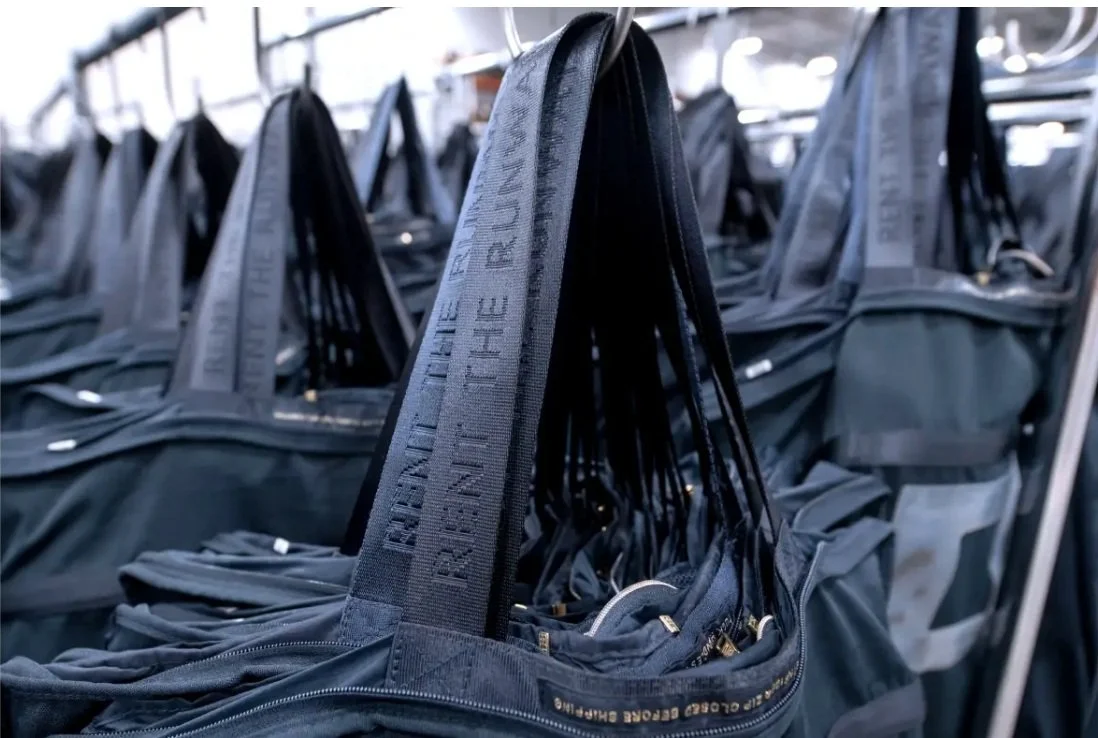
RtR has the largest in-house dry-cleaning facility in the world.  Their quality assurance teams are committed to enhancing the efficacy of cleaning processes and increasing rental garment longevity.  Upon a garment’s return, each items completes a wet, dry, spot or hydroxyl cleaning process using biodegradable detergents free from added fragrance, zeolites, halogenated solvents and PERC. Afterwards, the items are steamed between 248oF and 302oF in a steam tunnel, and then sealed in a polyplastic covering to preserve their quality. 

In efforts to be more environmentally sustainable, RtR ask customers to return their plastic coverings and hangers, along with their reusable garment bags. These items can be reused and recycled.  RtR’s recyclables are transformed into wood-alternative building materials thanks to a partnership with Trex.

Sources:

California Air Resources Board

https://ww2.arb.ca.gov/our-work/programs/phase-out-perchloroethylene-dry-cleaning-process

Minnesota Statutes, 92nd Legislature

https://www.revisor.mn.gov/laws/2021/0/Session+Law/Chapter/5/

Oxwash

https://www.oxwash.com/

RTR

https://www.renttherunway.com/content/cleanconfidence