Something Old, Something New

Diesel....Sustainable?

Glen Martens, best known for his early work at Jean Paul Gaultier and the high-end streetwear brand Y/Project, joined Diesel in October 2020. With Martens at its helm, Diesel is seeing the reformation that company founder, Renzo Rosso betted on when selecting him. Diesel has been a revered brand for nearly 40 years, but personally I remember the brand’s heyday during the early 2000s/Y2K era and all things Jeans Mania. On the red carpet, celebrities wore denim outfits adorned with the Diesel logo, while off-duty models donned Diesel's low-rise denim and the tiniest. Advertisements were radical and provocative.

Glen Martens - Forward Thinking in efforts to make Diesel a bit more sustainable

diesel fw 23

Diesel FW 23

Stepping into this role, Marten intends to do much more than create a few viral moments for the brand, instead opting for a more rooted approach. Initially, he will reevaluate the brand’s manufacturing channels and supply chain. He hopes to overlap the “then and now”, by embracing the company’s heritage through sparsely referencing its archives, as well as refitting some of the jeans by diversifying and expanding the range offered to customers. He also intends to extend the fundamentals the brand stands for by highlighting its progressive social and environmental values. Future collections will be made sustainable by using materials and dyeing methods that reduce the usage of water and harsh chemicals.

Marten has made substantial strides for specific sustainability initiatives: 

  • Launching the Denim Library Capsule

  • D:VERSE

  • Diesel Jean buyback program and Diesel Second Hand

The Denim Library Capsule is projected to account for more than 40% of brand sales. The current collection is derived from partly recycled fabrics, with the conceptual runway pieces being constructed using deadstock denim. Each of these pieces also has QR codes in pockets transparently detailing the steps of production supply chains. This collection offers a holistic approach to production using washes and treatments that minimize the use of water and chemicals. 

Not to be left out of the metaverse and Web3 arenas, Diesel is using technology innovation to gain the interest of GenZ and beyond. The brand debuted its own platform, D:VERSE, to host newly developed physical and virtual products.

Diesel’s jean buyback program and Secondhand circularity initiatives are available only in Milan, Florence, and Rome now with plans to expand. The buyback program launched in July 2021, and in just a few months over 900 pairs of jeans had been recovered and reconditioned. The restored jeans are treated with Polygiene’s anti-microbial and odor resistant ViralOff and Odor Crunch technology. The secondhand status of these items is identifiable by a bright red branded stamp on the waistband.
Taking a Global Look at EPR

epr-vintage-clothes

Fashion, fashion, fashion…the industry that impacts our environment more than we actually realize. As we navigate through our daily lives, buying the things we need, many may not want to acknowledge how much we consume and dispose of. Approximately 9.5 million tons of clothing are disposed of in North American landfills every year, and 85% of the world's textiles are burned or disposed of in landfills.

The fashion and textile industry on the whole accounts for approximately 10% of global greenhouse-gas emissions, when so many of the materials can be recycled or repurposed in some manner. Hundreds of billions are lost annually due to the underuse and negligent discarding of what we buy. Consumer waste is reversible by us. We can simply buy less, or shop sustainably which in part requires a shift in our consumption patterns.

Fighting Production Waste at its Source

Fashion designers and big brands produce large quantities of merchandise primarily based on consumer demand. And although many of those brands have taken voluntary action and initiatives to remedy their environmental impacts those individual efforts are not powerful enough. Circularity programs, reduction of single-use packaging or even switching completely to non-biodegradable packaging are great strides in neutralizing greenhouse gases; however, these sustainability targets cannot offset the carbon emissions produced by the fashion and textile industry. 

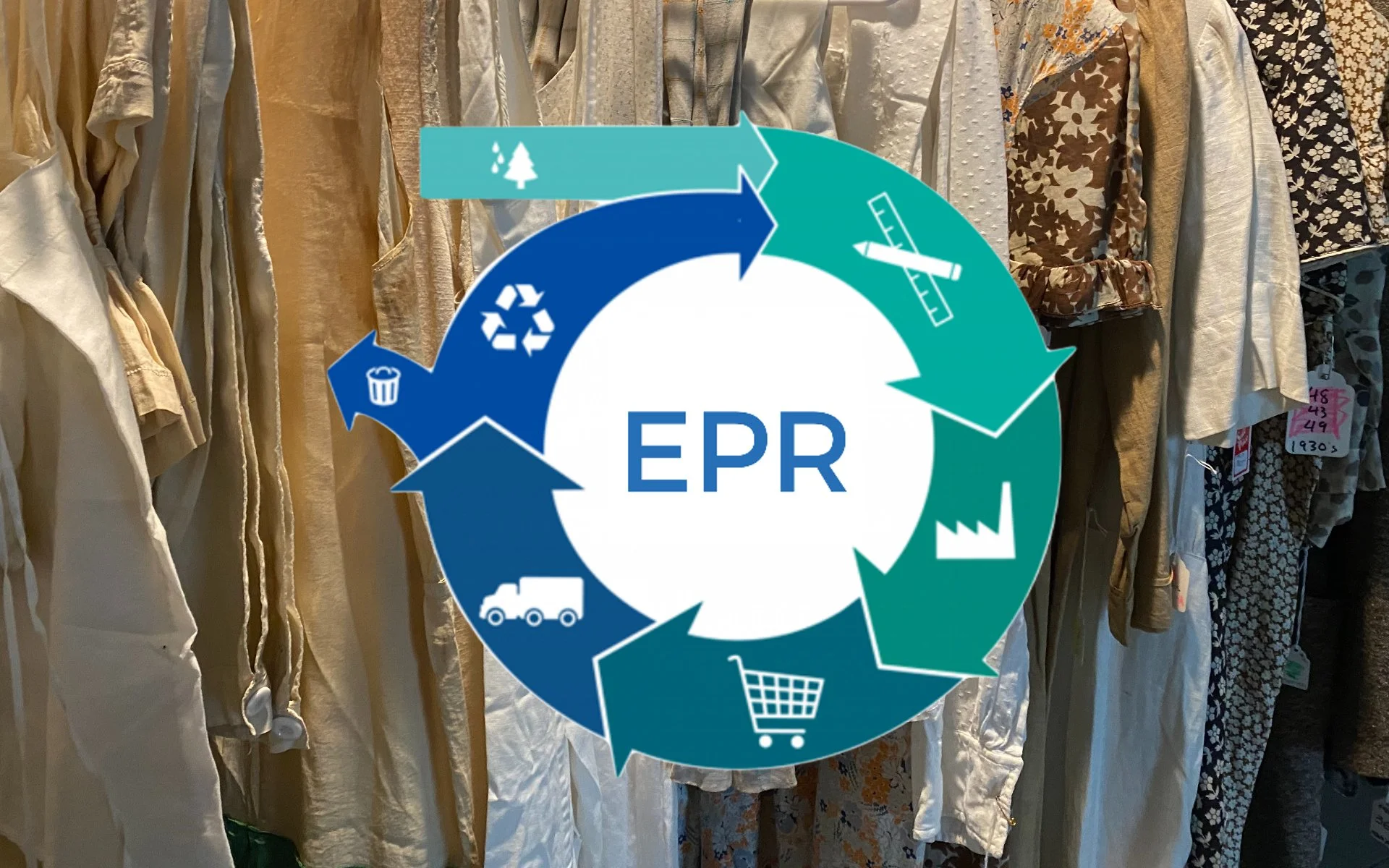
Some stakeholders and legislators believe EPR, or Extended Producer Responsibility, is a viable and sustainable answer to the ultimate elimination of textile waste. EPR is a policy approach that governs the post-consumer lifecycle of a product. It ensures that producers, not just brands, designers nor consumers, are held both physically and financially responsible for the appropriate disposal of their products and packaging. The enforcement of this policy is designed to promote positive environmental diversion, and in some cases incentivize producers for costs associated with end-of-life management.

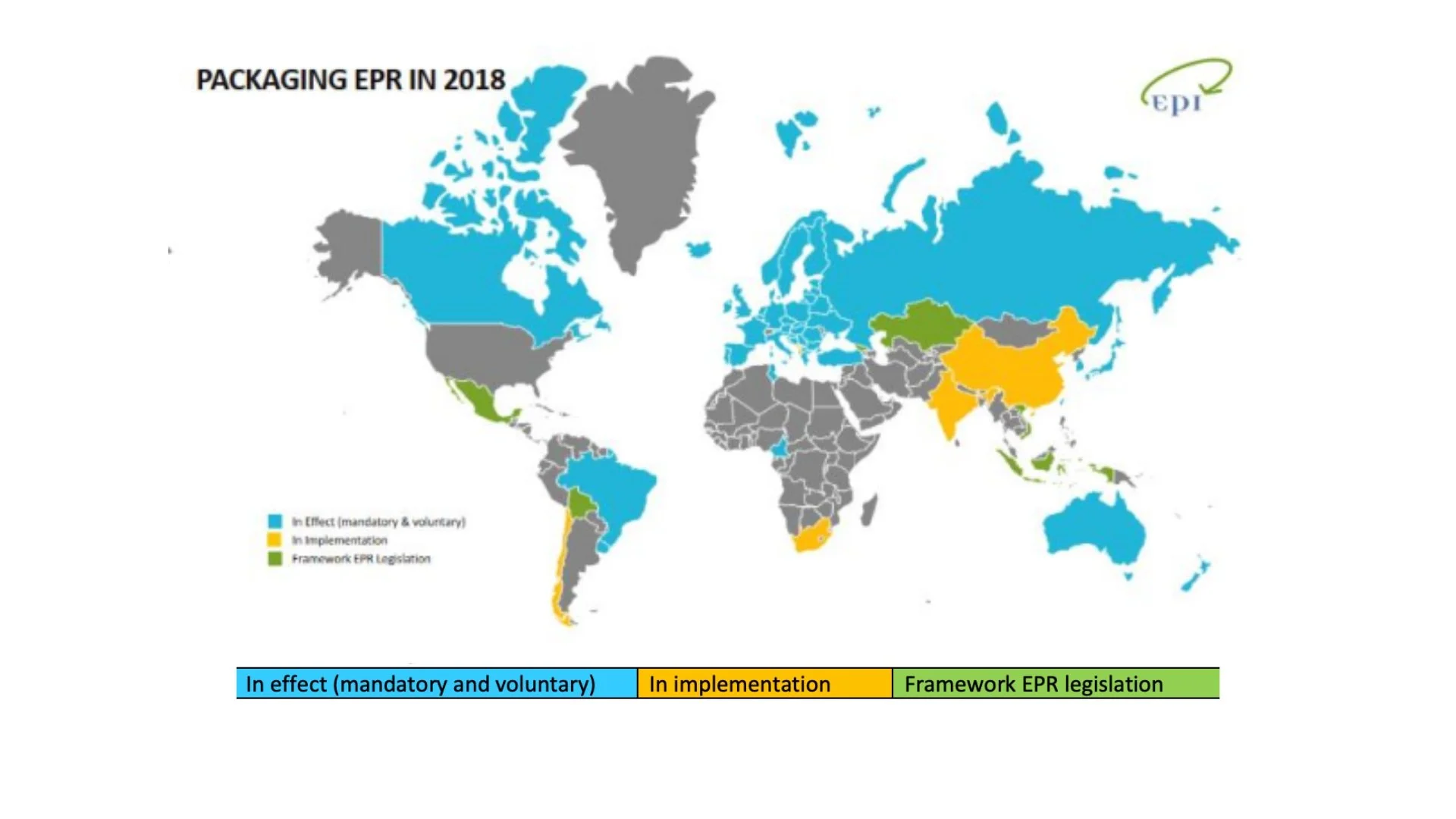
EPR Regulation by Country

map of EPR policy by country

image source: E. Watkins and S. Gionfra (2019) How to implement extended producer responsibility (EPR): A briefing for governments and businesses

Now I will give a small summary of how various countries have adopted EPR policies to shift responsibility to industry players (at all stages of the fashion value chain). This production waste, no matter the country, contributes to differing forms of environmental pollution including the degradation of water, air, and soil. Without significant improvement on operational and environmental shortcomings, systemic issues will continue, preventing the achievement of a net positive industry by 2050.

  • Netherlands - adopted EPR for textile taken effect July 1, 2023

    In the Dutch market, EPR applies to all parties along the supply chain, as they are all co-responsible for managing product waste from the fashion industry.  Textile manufacturers and importers are responsible for collecting, recycling and overall waste management phase of clothing and occupational clothing brought into the market, as well as the costs of logistics of the system.  The municipalities are responsible for covering all acquired cost associated with collecting and recycling any discarded clothing from their residents.

    Source: https://business.gov.nl/amendment/fashion-chains-must-collect-discarded-clothing/

  • Italy

    Italy’s Ministry of Environment and Energy Security (MASE), Ministry of Enterprise and “Made in Italy” (MIMIT) drafted a decree that obligates producers and key stakeholders in the textile industry to implement EPR provisions regarding design, production, disposal, and recycling of textiles.  Italy is aiming towards innovation in circular economy model within the textile supply chain, according to standards set by European Parliament for EU members.  

    Directive (EU) 2018/851 introduces provisions at improving the reuse and recycling of waste.  Moreover, Italy drafted a new decree stemming from this EPR directive which introduces important changes for textile manufacturers and producers:

1.    Producers will take responsibility for financing and organizing the collection, preparation for re-use, recycle and recovery of textile waste.

2.    Producers must use financial and organizational means to collaborate with relevant authorities using management systems to coordinate textile waste collection, as well as “selective collection systems to increase the quality of textile fractions”.

3. Pay environmental fee necessary to provide waste management service. 

4.    Manufacturers (especially of design phases of textile products) must ensure that they develop, produce and market products “suitable for reuse and repair”.  Products should contain recycled materials, have durability and is easily repairable.

5.    Meet specific eco-design measures such as: bio-compatible textile fibers and natural materials; eliminate hazardous components and substances (i.e. microplastics)

Source: https://www.twobirds.com/en/insights/2023/italy/2023-02-16-responsabilita-estesa-dei-produttori-nella-filiera-dei-prodotti-tessili

  • South Korea

    In South Korea, there are mandatory packaging recyclability evaluations that are in place to ensure that all producers, manufacturers, and importers comply with Korean Packaging Recycling Cooperative.  This measure has been in place since 2020.  Korean packaging producers and importers also must comply with a recyclability grade labelling system.  All elements of certain types of packaging (paper cartons, glass & PET bottles, aluminum cans and composite material film sheet) must be assessed individually as excellent, good, average, or difficult to recycle before proper authorities will confirm and provide Certificate of Packaging Grade. 

    EPR contribution rates are set based on packaging grades, which could potentially promote the use of “excellent to recycle” packaging for all.  However, if manufacturers and importers are non-compliant with recyclability grading system, consequences may include a ban on manufacturing, importation, sales or a fine not exceeding 1 billion KRW.

    Source:https://www.loraxcompliance.com/blog/env/2020/01/31/Republic_of_Korea_changes_its_recycling_requirements.html

  • Japan

    Since the early 2000s, Japan has been implementing EPR provisions.  Producers may utilize the national level scheme, registering with Japan Container and Packaging Recycling Association giving municipalities responsibility for waste collection, sortation, and transportation for a fee, or simply apply for approval to use an individual recycling system to handle the recycling on their own.

    Source:https://www.loraxcompliance.com/blog/env/2021/07/05/Existing_EPR_policies_in_Asia_Pacific.html

  • France

    In French territories, marketplace sellers (e.g. Amazon) offering products and merchandise must comply with EPR regulations.  To avoid suspension, french authorities require merchants to register packaging material usage according to the total number of consumer sale units.  There are one of three packaging declarations schemes for sellers based on the number of CSUs placed in France throughout a calendar year.

    Global VAT Compliance suggest sellers license a smaller number of materials than the first filing of each year.  GVC offers one of three packaging declarations, according to the total number of consumer sale units sold in France.

  • Germany

    Similar to France, by law, Germany requires all sellers introducing products to license or declare the materials that will be used for packaging.  This must be done in advance in the appropriate agencies. Failure to comply with EPR policy obligations will result in sellers on certain marketplaces being suspended.

    Source: https://www.globalvatcompliance.com/epr-extended-producer-responsibility/

Circularity at Coach-topia: Let's Buy "Nothing New"

In recent months, COACH has launched a sub-brand called COACH-topia. As a side note, if I'm talking about it here at SOSNU Co., there is an absolute chance it involves some degree of sustainability or circularity.

coach-by-coachtopia

COACH-Topia is a collaborative and inclusive start-up community of the brand’s designers, key partners and hundreds of Gen Z individuals interacting on the company’s Slack channel with products, concepts, and campaigns.  Coach's primary mission is to advance a circular fashion system that creates more sustainable products from waste in order to reimagine the end-to-end process. 

As is the case with many other conventional luxury brands, COACH is fully aware of the fact that new products and materials contribute 38% to the fashion industry's greenhouse gas emissions. Therefore, they are seeking to minimize their environmental impact. They understand the younger generation of shoppers are much more conscious and adamant about spending money with brands that take accountability for their impact on the climate crisis. Therefore, COACH founded COACH-topia, based on circularity.  COACH-topia is a sheer reimagining of the product lifecycle - forcing the brand to design backwards. Coach designers are exploring innovative technology to make and remake their products. In addition, they are using creative design innovations to keep their products and materials out of landfills.

As a means of minimizing virgin raw material use, COACH-topia designers create newness using what's already available. They use recyclable, renewable materials found in COACH’s production waste. The makers have recovered at least 50% recycled leather scraps, 95% recycled cotton, 70% recycled resin, 100% recycle polyester, and 40% bio based renewable sugarcane EVA to design beautiful offerings. 

The brand has released Ready-To-Wear, shoes, bags and small leather goods all created with the “Made Circular” design philosophy. The products are easily disassembled with removable screw back hardware and detachable leather handles and straps. This design innovation will hopefully keep COACH branded products and materials in rotation for years to come. COACH-topia hopes that through branding and collaboration with Gen Zers, they will be able to extend their reach and influence because they understand that circularity requires a shift in consumer mindsets.

SHOP COACH-topia

Shop COACH-topia online or visit one of the brand’s Reusable Stores. These Coach-topia pop-up stores also reflect the “Made Circular” philosophy completely. Everything from the hangers, fixtures, décor and even furniture is made using upcycled COACH materials or locally salvaged. Lastly, in the spirit of full circularity, all COACH-topia products can be traded in COACH retail stores in exchange for credit towards brand new items.

Sources:

https://www.prnewswire.com/news-releases/introducing-coachtopia-a-new-world-of-circular-craft-from-coach-powered-by-community-building-towards-a-better-future-for-our-planet-301802641.html

https://www.coach.com/shop/coachtopia/about